1

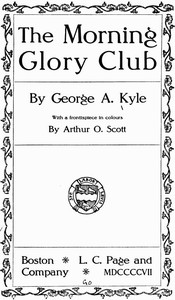
The Morning Glory Club — Reading Notes
(0 User reviews)
182
Project Gutenberg
2012
Not confirmed
Villages -- Fiction; New England -- Social life and customs -- Fiction; Women -- Societies and clubs -- Fiction
Readers of public-domain and historical texts
Project Gutenberg digital edition
en
Edition facts
Words
52,560
Reading time
229 min
Text sections
8
This digital edition of The Morning Glory Club — Reading Notes is described by source-level measurements including 52,560 words, 3 hr 49 min estimated reading time, and 8 detected text sections.
The text analysis averages about 12.8 words per sentence, while the detected sections provide another way to judge how the source is divided.
Project Gutenberg metadata also associates the work with “Villages -- Fiction,” connecting these edition facts with the source record’s subject description.
Source:
Project Gutenberg record #40899
An editorial note on George A. Kyle's 1907 novel, focusing on authorial choices in diction, dialogue, and description. The note examines the opening kitchen scene's marital power dynamics, Sam's dialect-heavy poster-making, and the narrative's use of ironic understatement, without claiming knowledge of the full plot.
Read the complete public-domain text at its original source.
Read on Project GutenbergThe Morning Glory Club opens not with a club meeting but with a married couple in a kitchen. Mrs. Tweedie, “bedaubing” a cake with “the skill of a professional plasterer,” announces that the house may one day bear a bronze tablet commemorating the founding of a women’s organization. Her husband Ezra, described as “little, ladylike,” responds with meek irony. The scene establishes a pattern of marital sparring in which Mrs. Tweedie’s boasts about her “tact” are undercut by the narrator’s aside that a relative’s intestate death secured the match. Kyle’s diction—words like “bedaubing,” “graven,” and “intestate”—signals a narrator who observes domestic comedy with a dry, slightly formal wit.
Marital Dialogue as Power Play
The opening exchange between the Tweeties is a study in indirect conflict. Mrs. Tweedie’s speech is grand and self-dramatizing: she speaks of “an organization that startled the community” and accuses men of causing “all of the trouble in the world.” Ezra’s replies are brief, deflecting, and laced with irony. When he says, “My only regret is that I shall not be here to see it—I mean the tablet, of course,” the parenthetical “of course” exposes his polite disbelief. Kyle uses the couple’s contrasting registers—hers oratorical, his understated—to dramatize a domestic struggle for authority. The narrator’s interjection that Ezra “might have added truthfully that, had it not been for her remarkable tact, and the fact that one of her relatives had indiscreetly died intestate during their courtship, he wou[ld not have married her]” is a rare moment of direct authorial commentary, revealing the economic subtext beneath the verbal sparring.
Dialect and the Amateur Advertiser
Sam’s poster-making episode showcases Kyle’s ear for rural New England dialect and his willingness to let characters reveal themselves through their own words. Sam’s speech is peppered with contractions and colloquialisms: “I want to borrer some big sheets of wrappin’ paper,” “I dunno, guess I’ll take a look at ’em anyway,” and “It’s jest what the show needs.” His poster, laboriously painted, is a comic masterpiece of misplaced enthusiasm: “BIG SHOW COME ONE COME ALL AND SEE THE MORNING GLORY CLUB in Shakespeare . Veterans Hall Manville Wed. Evg. Feb. 17, 18—, at eight o'clock SHARP doors open at seven tickets 25 cents RESERVED seats and children 15 cents EXTRA, no children and dogs in ARMS not admitted.” The absurd juxtaposition of “Morning Glory Club” with “Shakespeare,” the garbled punctuation, and the contradictory “no children and dogs in ARMS” all underscore Sam’s well-meaning but clueless ambition. Peter’s laconic responses—“They’ll be surprised all right”—provide a dry counterpoint.
Narrative Distance and Ironic Understatement
Kyle frequently employs a narrator who stands at a slight remove, offering wry observations without overt judgment. When Ezra’s smile fades to “a look that suggested a complication of homesickness and mal de mer,” the clinical French term for seasickness deflates the domestic tension with unexpected humor. Similarly, the description of Mrs. Tweedie’s gaze “fixed dreamily on a distant corner of the kitchen” undercuts her grand pronouncements by anchoring them in a mundane setting. The narrator’s habit of adding qualifying clauses—as in “He might have added truthfully that…”—creates a sense of withheld information, inviting the reader to infer what is left unsaid. This technique is consistent across the excerpts: the narrator reports actions and speech but rarely explains motives, leaving characters’ inner lives to be deduced from their dialogue and behavior.
Setting as Social Stage
The novel’s settings—a kitchen, a general store, a barn—are not mere backdrops but active elements in the social drama. Mrs. Tweedie’s kitchen, with its cake and “distant corner,” is the site of her domestic empire-building. Peter’s store, with its kerosene barrel and back room full of “oil, molasses, vinegar, empty boxes,” is a hub of male gossip and commerce. Sam’s retreat to the barn to examine “old circus bills” reinforces the gendered division of space: the women’s club meets indoors, while Sam’s advertising campaign originates in a barn, a space associated with manual labor and masculine tinkering. Kyle’s descriptions are economical but telling: the store’s “smiling what-will-you-have-this-morning look” of the customer, the “how-shall-I-begin look” on Sam’s face. These small gestures accumulate into a portrait of a community where every action is observed and judged.
Readers attentive to Kyle’s authorial choices will find a novel that rewards close attention to its verbal texture. The dialogue, with its class and gender inflections, carries much of the narrative weight; the narrator’s ironic asides provide a counterpoint that is often more revealing than the characters’ own statements. The excerpts suggest a work more interested in social comedy than in plot mechanics, and one that uses the club as a lens to examine small-town dynamics. Approach the text as a study in voices and silences, and note how much is conveyed through what is left unsaid.
There’s something tender in how Kyle lets Sam’s dialect carry his longing, the awkward posters speaking more than clean prose ever could. I kept thinking about that quiet ache while rereading later notes on The Duke's Sweetheart: A Romance — Reading Notes, another story where people fumble toward each other through imperfect words. Old books remember us that way, too.
There are no reviews for this eBook.
There are no comments for this eBook.
Reader reflection
What was your reading experience?
Capture what you thought, learned, and would like to remember.
Your progress
0
/
10
2
What was your overall reaction to the book?
3
Would you encourage someone else to read it?
4
How demanding did the text feel?
5
How well did it match your expectations?
6
Would this book work well in a reading group?
7
How much did the book move you?
8
What did you appreciate most?
9
In one sentence, what did you learn?
10