1

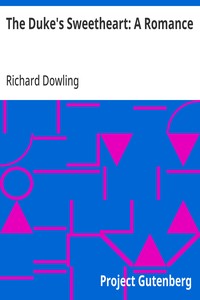
The Duke's Sweetheart: A Romance — Reading Notes
(0 User reviews)
834
Project Gutenberg
2013
Not confirmed
England -- Social life and customs -- 19th century -- Fiction; Man-woman relationships -- Fiction; Aristocracy (Social class) -- Fiction
Readers of public-domain and historical texts
Project Gutenberg digital edition
en
Edition facts
Words
103,437
Reading time
450 min
Text sections
13
The catalog record for The Duke's Sweetheart: A Romance — Reading Notes provides practical reading context through 103,437 words, 7 hr 30 min estimated reading time, and 13 detected text sections.
The text analysis averages about 17.0 words per sentence, while the detected sections provide another way to judge how the source is divided.
Project Gutenberg metadata also associates the work with “England -- Social life and customs -- 19th century -- Fiction,” connecting these edition facts with the source record’s subject description.
Source:
Project Gutenberg record #42599
Richard Dowling's 1885 romance follows Charles Augustus Cheyne, a physically imposing Fleet Street writer nicknamed 'Duke of Long Acre,' whose life intersects with the aristocratic Duke of Shropshire. The catalog subjects of English social customs and class relations are present, but the excerpts emphasize Cheyne's non-aristocratic identity, his literary fame, and a shipwreck that blurs social boundaries.
Read the complete public-domain text at its original source.
Read on Project GutenbergThe title character of Richard Dowling's 1885 romance is not a peer of the realm but a Fleet Street writer nicknamed the 'Duke of Long Acre' by his colleagues. Charles Augustus Cheyne, six feet tall and fifty inches around the chest, can bend a kitchen-poker into a triangle and back again. He owns no land, no stocks, and no title recognized by the Heralds' College. The catalog subjects list 'Aristocracy (Social class) — Fiction,' but the excerpts show a protagonist who earns his living by his brain and fingers, not by inheritance. The romance's tension lies in the gap between Cheyne's physical strength and his social standing, and in the accidental connection forged when a shipwreck brings him into contact with the actual Duke of Shropshire.
A Duke by Courtesy, Not by Blood
The opening chapter establishes Cheyne as a man whose ducal title is purely honorary, conferred by 'untitled citizens of the Republic of Letters.' Dowling emphasizes Cheyne's physicality—his size, his strength, his close-cropped dun-colored hair—as if to compensate for his lack of hereditary status. The narrator notes that Cheyne 'had never struck a man in anger,' despite being assaulted, suggesting a deliberate contrast between his formidable body and his pacific nature. This inversion of aristocratic expectations—a duke who works with his hands, who is known for his good temper rather than his lineage—sets up a central irony that the catalog subject 'Aristocracy (Social class)' only partially captures. The excerpts do not reveal whether Cheyne ever gains land or title, but they make clear that his identity is built on personal achievement, not birth.
The Shipwreck as Social Collision
The excerpts contain two shipwreck scenes. In the first, Cheyne rescues a nobleman who leaves the yacht Seabird as Marquis Southwold and later becomes the eighth Duke of Shropshire. In the second, the bodies of the Duke and a sailor are found in a cove, along with a three-volume novel by Cheyne titled The Duke of Fenwick. The discovery of the novel near the dead Duke leads the 'simple people' to assume it belonged to him, and they send it to the Castle with the corpse. This detail—a book about a duke found beside a duke—literalizes the confusion between fictional and real aristocracy. The catalog subject 'Man-woman relationships' is not prominent in these excerpts; instead, the romance seems to pivot on the collision of social worlds, mediated by a shipwreck that forces physical proximity between a writer and a peer.
Miss Traynor's Settled Notions
In a later excerpt, the narrative shifts to the household of Marion Durrant and her invalid aunt, Miss Traynor. Miss Traynor is described as 'old-fashioned and kindly,' with 'a great number of settled notions' acquired decades earlier. She admires Church and State, considers all Liberals 'murderers and regicides at heart,' and believes The Times infallible. Her opinions are presented with gentle satire: she 'could have read with lively satisfaction that all the Liberals and Radicals had been drowned, provided all detail were omitted, and a bishop had something to do with the matter.' This character offers a window into the domestic and ideological setting that the catalog subject 'England — Social life and customs — 19th century' implies. Her rigid worldview contrasts with Cheyne's self-made status, suggesting that the romance may explore how fixed social attitudes encounter the fluid reality of a man who is a duke in name only.
The excerpts from The Duke's Sweetheart reveal a novel more interested in the ironies of social identity than in conventional romantic plot. The catalog subjects point toward class and custom, but the text itself dwells on physical strength, literary fame, and the accidental mingling of ranks. Readers should attend to how Dowling uses Cheyne's body and his book as symbols that complicate the very idea of aristocracy. The romance may ultimately be less about a love story than about the strange kinship between a writer who calls himself a duke and a duke who dies with a novel in his hands.
Reading The Duke’s Sweetheart, I kept thinking about how shipwrecks strip away titles, leaving just the person clinging to the wreckage. There’s a similar quiet unraveling in the old house of The Grim House — Edition Insights, where walls hold secrets longer than families do. Strange, how time softens our certainties into something gentler, almost like memory.
There are no reviews for this eBook.
There are no comments for this eBook.
Reader reflection
How will you remember this book?
Save your reaction, strongest insight, and memorable passage.
Your progress
0
/
10
2
What was your overall reaction to the book?
3
Would you encourage someone else to read it?
4
How demanding did the text feel?
5
How did the reading compare with what you expected?
6
Would you start a conversation about this book?
7
How original did the book feel?
8
How valuable was this book for your own interests?
9
What changed or sharpened your thinking?
10