1

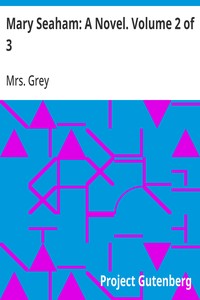
Mary Seaham: A Novel. Volume 2 of 3 — Text and Context
(0 User reviews)
117
Project Gutenberg
2012
Not confirmed
Young women -- Fiction; Mate selection -- Fiction; Great Britain -- Social life and customs -- 19th century -- Fiction
Readers of public-domain and historical texts
Project Gutenberg digital edition
en
Edition facts
Words
54,154
Reading time
236 min
Text sections
7
This digital edition of Mary Seaham: A Novel. Volume 2 of 3 — Text and Context is described by source-level measurements including 54,154 words, 3 hr 56 min estimated reading time, and 7 detected text sections.
The text analysis averages about 27.8 words per sentence, while the detected sections provide another way to judge how the source is divided.
Project Gutenberg metadata also associates the work with “Young women -- Fiction,” connecting these edition facts with the source record’s subject description.
Source:
Project Gutenberg record #40406
This editorial note examines the narrative voice and shifting pace in Volume 2 of Mrs. Grey's Mary Seaham, focusing on the author's use of moral commentary, psychological scrutiny, and structural changes to reveal character and tension.
Read the complete public-domain text at its original source.
Read on Project GutenbergMrs. Grey's narrative voice in Mary Seaham, Volume 2, operates as a persistent moral commentator, frequently breaking the surface of action to deliver aphoristic judgments. In the opening chapter, the narrator describes Arthur Seaham's glance as 'a very Ithuriel spear in the way of discernment and discrimination,' a simile that both characterizes Arthur and signals the novel's interest in penetrating disguise. This habit of explicit evaluation—calling Eugene's conduct 'specious' and noting the 'harmony of character and propensity' between father and son—creates a deliberate, measured pace in expository passages. Yet the pace shifts markedly in scenes of heightened emotion, where the prose becomes more compressed and elliptical, as when the narrator alludes to 'deeds of darkness' without immediate elaboration. These variations in tempo are not arbitrary; they correspond to the narrator's shifting focus from social observation to psychological revelation.
The Moral Commentator as Narrator
The narrator of this volume does not merely report events but interprets them through a consistent moral lens. When Arthur Seaham scrutinizes Eugene, the narrator adds that Arthur's judgment 'no outward gloss, no specious disguise could blind or beguile.' This is not free indirect discourse but an authorial intrusion that aligns the reader with Arthur's discernment. Similarly, in Chapter XIII, the narrator reflects on the bond between Mr. Trevor and Eugene: 'Alas! when evil, not good cements the union of man with man—when hand joins hand, for deeds or purposes of darkness.' Such passages slow the narrative to a contemplative pace, inviting the reader to consider the ethical dimensions of the plot. The narrator's voice is consistent in its disapproval of hypocrisy and its sympathy for those who are 'infatuated' or deceived, as when Mary is described as seeing Eugene as 'an angel of light.' This moral commentary is not merely decorative; it shapes the reader's expectations and deepens the tension between appearance and reality.
Shifts in Pace: From Social Ease to Psychological Pressure
The volume exhibits distinct changes in narrative pace that mirror the characters' internal states. Early chapters, such as the meeting between Arthur and Eugene, proceed with a leisurely, conversational rhythm. The dialogue is cordial, and the narrator's observations are expansive, as when Arthur's 'clear eyes' scan Eugene 'with a critical interest he attempted not much to disguise.' The pace here is unhurried, allowing for detailed character introduction. However, as the volume progresses and darker undercurrents emerge, the prose becomes more compressed. In Chapter XIII, the narrator shifts to a terse, almost breathless style: 'In its train / Follow all things unholy—love of gold— / The phantom comes and lays upon his lids / A spell that murders sleep.' This poetic interlude, quoting N. P. Willis, marks a sudden acceleration into heightened emotion. The subsequent prose is dense with implication, referring to 'a suspicious cloak over one era of Eugene Trevor's early history' without full disclosure. This withholding of information creates a sense of urgency and foreboding, contrasting with the earlier, more expansive social scenes.
Recurring Imagery and the Language of Concealment
Throughout the excerpts, a pattern of imagery related to sight, disguise, and hidden knowledge emerges. Arthur's 'Ithuriel spear' is the first of several references to penetrating vision. Later, the narrator speaks of Eugene's 'outward conduct and demeanour' as a 'seeming mark of gratitude' that conceals his true motives. The bond between father and son is described as 'a bond of union, the more strengthened and annealed as years wore on,' using metallurgical language to suggest a hidden, forged connection. The most striking image is that of the 'suspicious cloak' over Eugene's past, which 'no member of his family save his father ever penetrated.' This language of veiling and unveiling is central to the novel's method: the narrator repeatedly hints at secrets while maintaining a deliberate opacity. The effect is to create a layered reading experience, where the surface narrative of courtship and family life is undercut by a subtext of moral danger and concealed transgression. The reader is positioned as a detective, piecing together clues from the narrator's guarded revelations.
Readers of this volume should attend closely to the narrator's asides and the shifts in prose rhythm, as these signal crucial developments in character and plot. The moral commentary is not mere ornament but a guide to the novel's ethical concerns. The pace changes—from expansive social scenes to compressed, allusive passages—reflect the tension between public decorum and private corruption. By observing how Mrs. Grey manipulates tempo and voice, one can trace the gradual revelation of Eugene Trevor's character and the mounting pressure on Mary Seaham's happiness.
Years among these shelves taught me that Mrs. Grey's careful, unhurried peeling of Mary's conscience in Volume 2 has a quiet echo—a kinship with the patient observation of Two Studios. Both whisper, rather than proclaim; their truth unfolds between lines, like a room slowly revealed by dawn. I have set them side by side, as old friends might rest together. Two Studios — Inside the Classic.
There are no reviews for this eBook.
There are no comments for this eBook.
Reader reflection
Your personal reading reflection
Build a private reading journal entry for this title.
Your progress
0
/
10
2
What was your overall reaction to the book?
3
Would you encourage someone else to read it?
4
How demanding did the text feel?
5
Did the book offer a fresh perspective?
6
What was its emotional impact?
7
How did the reading compare with what you expected?
8
Which part made the strongest impression?
9
What did this book teach you most?
10