1

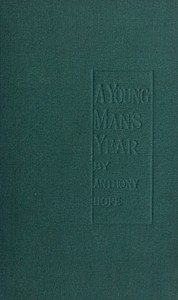
A Young Man's Year — Reading Companion
(0 User reviews)
735
Project Gutenberg
2013
Not confirmed
Young men -- Fiction; Man-woman relationships -- Fiction; England -- Social life and customs -- Fiction; Lawyers -- Fiction
Readers of public-domain and historical texts
Project Gutenberg digital edition
en
Edition facts
Words
121,591
Reading time
529 min
Text sections
11
This digital edition of A Young Man's Year — Reading Companion is described by source-level measurements including 121,591 words, 8 hr 49 min estimated reading time, and 11 detected text sections.
The text analysis averages about 14.0 words per sentence, while the detected sections provide another way to judge how the source is divided.
Project Gutenberg metadata also associates the work with “Young men -- Fiction,” connecting these edition facts with the source record’s subject description.
Source:
Project Gutenberg record #43083
Anthony Hope's 1915 novel follows Arthur Lisle, a young barrister in London, as he navigates professional stagnation, romantic entanglements, and the tensions between idealism and suspicion. The narrative contrasts dreary legal chambers with the country estate Hilsey, where Arthur observes a married woman, Bernadette, and her suitor Sir Oliver, sparking a new, possessive jealousy.
Read the complete public-domain text at its original source.
Read on Project GutenbergThe novel opens with Arthur Lisle staring out a window in the Middle Temple on a 'dark, dank, drizzly' Monday morning, a setting that immediately establishes a tone of dreary confinement. His chambers are described as a 'cell of a room,' and his legal career as 'waiting for work'—a tedious preparation for a vocation that never arrives. This opening image of paralysis and frustration sets the stage for a narrative that will repeatedly contrast Arthur's stagnant London life with the more vibrant, morally ambiguous world of Hilsey, the country estate where much of the action unfolds.
The Language of Restraint and Observation
Hope's prose is marked by a careful, almost clinical attention to gesture and posture. Arthur is frequently seen 'standing with his hands in his pockets, listlessly staring,' a posture that recurs throughout the excerpts. When he observes Bernadette and Sir Oliver framed in a doorway, the narrative slows to note 'pose or air or look,' treating the scene as a 'picture of lovers.' This visual emphasis extends to dialogue, where characters often speak in ironic or guarded exchanges. Judith Arden's cool irony—'I spoke rather in a spirit of resignation'—and Sir Oliver's urbane self-possession create a surface of civility that barely conceals underlying tensions. The text repeatedly invites readers to read between lines, to interpret what is left unsaid.
Contrasting Spaces: London and Hilsey
The excerpts present two sharply opposed settings. London is defined by the 'dull drab' of the Middle Temple, a place of 'tedious and weary preparation' where Arthur 'cursed his means of subsistence.' Hilsey, by contrast, is associated with lawns, woods, and summer seas—a space of leisure and possibility. Yet this pastoral setting is also a stage for intrigue. The country house becomes a site of observation and suspicion, where Arthur's 'new feeling' of jealousy emerges. The contrast is not merely scenic but moral: the city's stagnation gives way to a countryside where relationships are fluid and motives opaque. Hope uses these spatial oppositions to underscore Arthur's psychological journey from passive frustration to active, if conflicted, engagement.
The Emergence of Possessive Jealousy
Arthur's emotional arc in the excerpts moves from 'honest, pure, and without self-regard' adoration to a 'compound of anger and fear.' The catalyst is a single image: Bernadette and Sir Oliver 'framed, as it were, by the doorway of her room.' This visual triggers a 'new current of feeling' that Arthur himself struggles to name. He protests to Judith that his devotion was selfless, but the narrative undercuts this claim: 'So it had, while no one shared or threatened it.' The text traces the birth of a possessive desire, one that arises not from love alone but from the fear of losing a potential object of affection. This psychological shift is rendered through interior monologue and the tension between Arthur's rational doubts and his visceral suspicions.
Readers should attend to the novel's subtle use of framing and perspective. Hope often filters events through Arthur's consciousness, but the narrative leaves room for ambiguity—are his suspicions justified, or are they projections of his own awakening desires? The excerpts offer no definitive answer, only a series of carefully observed moments that invite interpretation. The tension between what characters say and what they reveal through posture, tone, and setting is the novel's central method.
That rainy afternoon, Arthur’s restless jealousy in A Young Man’s Year felt almost like a familiar ache, the way suspicion creeps where certainty should be. I closed it and found myself thinking of quieter loyalties, and somehow drifted to Stand Fast, Craig-Royston! (Volume I) — Background and Themes, where steadfastness offers a gentler counterweight to that same restless heart. The rain kept falling, and I let it.
There are no reviews for this eBook.
There are no comments for this eBook.
Reader reflection
What did you think of this book?
Answer a few questions and save a private reflection on this device.
Your progress
0
/
10
2
What was your overall reaction to the book?
3
Is this a title you would suggest to others?
4
How easy was the book to follow?
5
What did you think about the pace?
6
Could you see yourself revisiting this book?
7
Did this book create an emotional response?
8
How did the reading compare with what you expected?
9
Which lesson or insight stayed with you?
10