1

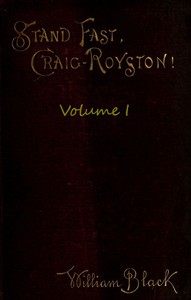
Stand Fast, Craig-Royston! (Volume I) — Background and Themes
(0 User reviews)
569
Project Gutenberg
2013
Not confirmed
Grandfathers -- Fiction; Scotland -- Social life and customs -- 19th century -- Fiction; Families -- Fiction; Older people -- Fiction
Readers of public-domain and historical texts
Project Gutenberg digital edition
en
Edition facts
Words
59,691
Reading time
260 min
Text sections
7
For Stand Fast, Craig-Royston! (Volume I) — Background and Themes, the stored edition analysis reports 59,691 words, 4 hr 20 min estimated reading time, and 7 detected text sections.
The text analysis averages about 21.9 words per sentence, while the detected sections provide another way to judge how the source is divided.
Project Gutenberg metadata also associates the work with “Grandfathers -- Fiction,” connecting these edition facts with the source record’s subject description.
Source:
Project Gutenberg record #42729
William Black's novel opens in Piccadilly with an elderly Scotsman and his granddaughter, whose striking appearance draws attention. The narrative then shifts to their lodgings, revealing the grandfather's secretive inquiries and nocturnal visits to a newspaper office, hinting at hidden motives.
Read the complete public-domain text at its original source.
Read on Project GutenbergThe novel begins on a sunny May afternoon in Piccadilly, where an elderly man in shepherd's tartan plaid and a young girl with remarkable hair—neither flaxen, golden, nor brown—draw swift glances from the fashionable crowd. The girl, Maisrie Bethune, keeps her eyes downcast, but when she raises them, her blue-grey eyes reveal a 'mild-shining light, timid, mysterious, appealing almost.' Her grandfather, George Bethune, is described with 'flowing hair and beard almost silver-white' and eyes 'alert and confident as with the audacity of youth.' This initial tableau establishes a contrast between the pair's rustic appearance and the urban setting, hinting at a story rooted in displacement and hidden histories.
A Striking Entrance and a Veiled Past
The opening chapter introduces the Bethunes through the eyes of passers-by, emphasizing their otherness. The old man's 'plaid of shepherd's tartan' and the girl's 'sun-tan over her complexion, that spoke of travel' immediately mark them as outsiders in London. Maisrie's beauty is described in elaborate detail, but her diffidence—'she rarely raised her eyes from the pavement'—suggests a guardedness that contrasts with her grandfather's confident demeanor. The narrative voice lingers on her hair's shifting colors, a device that both celebrates her uniqueness and underscores the fleeting, observational nature of the scene. This opening establishes a dynamic of visibility and concealment that will likely recur.
Domestic Tensions and Secret Errands
Later excerpts shift to the Bethunes' lodgings, where the grandfather's interactions with the landlady's husband, Hobson, reveal a manipulative streak. After Hobson reports the address of a young man, George Bethune feigns indifference—'I cannot say that I have any particular curiosity'—while clearly having orchestrated the inquiry. The scene is tinged with class dynamics: Hobson's eyes linger on 'hot water and whisky,' but he receives no invitation. This moment of petty deception is followed by the grandfather's nocturnal wanderings, during which he sings Scottish songs and eventually visits a newspaper office. His destination—the Edinburgh Chronicle—and his exchange with the correspondent Mr. Fox, who jests about Scottish frugality, hint at a connection to journalism or publishing that may be central to the plot.
Scottish Identity and Urban Displacement
Throughout the excerpts, Scottishness is a persistent motif. The grandfather's plaid, his singing of 'London's bonnie woods and braes' and 'Cam' ye by Athol,' and his dignified retort about 'the most generous and hospitable people' all reinforce a cultural identity that feels out of place in London. Mr. Fox's teasing—'You are always girding at Scotland, Mr. Fox'—and his joke about Shakespeare learning economy from the Scotch suggest a tension between the old man's pride and the correspondent's condescension. The setting of Fleet Street, 'a hive of industry' with 'special wires' and 'London correspondents,' contrasts sharply with the pastoral imagery of the songs, underscoring the characters' dislocation. This juxtaposition of rural Scottishness and urban English commerce may drive the narrative's central conflicts.
Narrative Structure and Reader Expectations
The excerpts offer a fragmented view of the novel's first volume. The opening chapter's detailed physical description and the later domestic scene with Hobson suggest a pattern of observation and revelation: characters are introduced through their appearance and actions, with motives slowly uncovered. The grandfather's secretive visit to the newspaper office introduces a subplot involving journalism or correspondence, but the excerpts do not reveal its purpose. The young man whose address Hobson obtains remains unnamed, and Maisrie's role beyond being a silent companion is unclear. Readers should expect a gradual unfolding of backstory, with the grandfather's past and his relationship to Maisrie likely central. The novel's title, Stand Fast, Craig-Royston!, may refer to a place or motto, but the excerpts provide no direct clue.
These opening chapters establish a world of contrasts—youth and age, Scotland and London, visibility and secrecy. The narrative voice is observant and slightly ironic, particularly in its treatment of the grandfather's pretensions. As you read, pay attention to how the author uses setting and physical detail to suggest inner states, and note the recurring motif of watching and being watched. The fragments of Scottish song and the newspaper office hint at a story that may intertwine personal history with broader cultural tensions.
I think of that old Scotsman in Stand Fast, Craig-Royston!, so guarded in his errands, and how his quiet scheming reminded me of another book’s gentler secrets. There’s a similar hush in The Rubicon — A Reader’s Guide, as if both volumes understood that what we hide often says more than what we speak. A comfortable, knowing pair.
There are no reviews for this eBook.
There are no comments for this eBook.
Reader reflection
Your personal reading reflection
Build a private reading journal entry for this title.
Your progress
0
/
10
2
Did this book hold your interest?
3
Would you pass this book on to a friend?
4
Did the language feel accessible?
5
What did you appreciate most?
6
Was the book easy to understand?
7
Would you like to discuss this book with someone?
8
Did any part of the book stay with you emotionally?
9
What changed or sharpened your thinking?
10