1

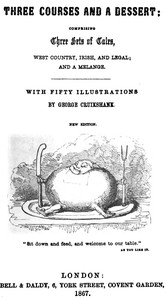
Three Courses and a Dessert Comprising Three Sets of Tales, West Country, Irish, and Legal; and a Melange — Reading Notes
(0 User reviews)
60
Project Gutenberg
2014
Not confirmed
Ireland -- Social life and customs -- Fiction; Legal stories, English; West Country (England) -- Social life and customs -- Fiction
Readers of public-domain and historical texts
Project Gutenberg digital edition
en
Edition facts
Words
174,000
Reading time
757 min
Text sections
17
The catalog record for Three Courses and a Dessert Comprising Three Sets of Tales, West Country, Irish, and Legal; and a Melange — Reading Notes provides practical reading context through 174,000 words, 12 hr 37 min estimated reading time, and 17 detected text sections.
The text analysis averages about 25.4 words per sentence, while the detected sections provide another way to judge how the source is divided.
Project Gutenberg metadata also associates the work with “Ireland -- Social life and customs -- Fiction,” connecting these edition facts with the source record’s subject description.
Source:
Project Gutenberg record #44560
An 1867 collection of tales in four parts—West Country, Irish, Legal, and a Melange—with George Cruikshank illustrations. The opening Induction frames the book as a meal, while the West Country and Irish excerpts show rustic humor, dialect, and supernatural touches. A first reading reveals how the author varies voice and setting across courses.
Read the complete public-domain text at its original source.
Read on Project GutenbergThe Induction addresses readers as guests at a “feast of reason,” with the author disclaiming blame for any faults in the decorations, which he credits to George Cruikshank. The Latin tag Quod tetigit, ornavit (whatever he touched he adorned) signals the illustrator’s importance. This framing invites you to treat each tale as a separate dish, sampled at will.
The First Course, “West Country Chronicles,” opens with a claim that the true old English squire is nearly extinct, and that the following narratives were gleaned from one such squire’s discourse. The voice is genial and anecdotal, setting expectations for a leisurely, oral-style collection.
The Induction as a Menu
The Induction is more than a preface: it establishes the book’s structure as a meal with three courses and a dessert. The author hopes that “those who may discover nothing to their taste in one course, will meet with something piquant in another.” This is a direct invitation to skip or browse. The metaphor extends to the plates—the illustrations—which the author insists will please even if the dishes do not. The Latin motto and the self-deprecating tone (“perhaps rashly, presented himself at the bar of public opinion”) suggest a writer conscious of his audience’s judgment. For a first reading, note how this framing lets you treat each tale independently.
West Country Chronicles: Oral Storytelling
The West Country section begins with an introduction that claims the tales were “gleaned” from a squire’s discourse, thanks to “the delinquency of a dog.” This anecdotal origin sets a conversational tone. In the excerpt from “Bat Boroo,” the narrator uses direct address (“Now for the event I promised to tell you about”) and colloquial asides (“and you wouldn’t wonder, if you saw it yourself”). The prose is rich with dialect and sensory detail: a stick “made of wood that never grew in a Christian land,” a face “as ugly as ever you saw in a dream after taking a tough supper.” The humor is broad and physical—tickling a sleeping woman’s nose with a barley-straw. Pay attention to how the narrator’s voice shifts between rustic and knowing.
Irish Tales: Dialect and Superstition
The Irish course introduces Duck Davie, a boy who torments his grand-aunt’s maid, “ould Alice.” The dialect is thick: “I mane that of a stick descending with force upon his back.” The story blends folk motifs—a hollow oak, a sleeping crone, a carved staff—with a trickster’s comeuppance. Duck’s malice is described with comic exaggeration: he picks thistles to put in her bed. The supernatural element (the staff “made of wood that never grew in a Christian land”) is undercut by the mundane outcome: a blow from the stick. The narrator’s direct questions (“Did you ever get your nose tickled that way while you were asleep?”) create a conspiratorial intimacy. For a first reading, note how the Irish tales differ in pacing and dialect from the West Country ones.
Legal and Dessert: A Change of Tone
The Third Course, “My Cousin’s Clients,” and the Dessert are not excerpted here, but the table of contents hints at a shift. Legal stories like “Adam Burdock” and “The Mathematician” suggest a more urban, professional setting, while the Dessert includes titles such as “The Deaf Postilion,” “Conjugating a Verb,” and “A Toad in a Hole.” These appear to be shorter, perhaps more whimsical pieces. The illustration credits and the author’s note that the sketches were “translated into a proper pictorial state” by Cruikshank remind you that the visual element is integral. Without the full text, you can only infer that the later sections may offer a contrast in subject and style. A first reader might sample one tale from each course to gauge the variety.
Because the collection is designed as a menu, you are free to read the courses in any order. The Induction’s apology for a “feast of reason” is a polite warning: not every dish will suit every palate. The West Country and Irish excerpts share a fondness for dialect, physical comedy, and supernatural hints, but the Legal and Dessert sections likely introduce new registers. Let Cruikshank’s illustrations guide your pauses—they are the “plates” the author promises will please.
That old 1867 book felt like sitting through a long dinner where each story arrived as a different course—rustic, then wry, then strange. It stayed with me for the unhurried way voices shifted between settings. I found a similar quiet companionship in The Young O'Briens: Being an Account of Their Sojourn in London — Reading Companion, which lingers with the same tender patience, only it’s all one family’s warm, wandering story.
There are no reviews for this eBook.
There are no comments for this eBook.
Reader reflection
Take a moment to reflect on this book
Create a short personal record of your experience with this book.
Your progress
0
/
10
2
Did this book hold your interest?
3
Would you encourage someone else to read it?
4
What was the reading difficulty like?
5
How well did it match your expectations?
6
Which aspect of the book did you value most?
7
How personally connected did you feel to the book?
8
What did you think about the pace?
9
What is the main idea you are taking away?
10