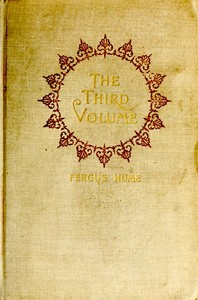
The Third Volume
Edition facts
Spenser Tait, a methodical bachelor whose chambers in Earls Street, St. James', are kept with 'old maidish' precision by his valet Dormer, serves as the amateur detective in Fergus Hume's 1894 novel. The opening establishes Tait's fastidious nature—'the neatest and most methodical of men'—which later informs his analytical approach to a cold case. The story unfolds through a series of deductions and counter-arguments, as Tait and his interlocutor Claude Larcher debate the guilt of several suspects in the murder of Claude's father. The excerpts reveal a narrative structured around competing theories rather than linear detection, with Tait constructing cases against Claude's mother, a servant named Jeringham, and a mysterious figure named Denis.
The Detective's Method: Circumstantial Webs
Tait's investigative style is less about gathering clues than about constructing plausible narratives from known facts. In one passage, he builds a case against Denis by linking a mother's confession, a dropped dagger, and an impulsive Irish temperament: 'With his impulsive Irish temperament he dashes in, hot to avenge the wrong done to his sister. The dagger dropped by your mother is at his feet; he picks it up and kills his master on the instant.' This theory is presented as 'pure theory,' yet Tait defends it as 'as circumstantial as the rest of the evidence we have in hand.' The novel thus foregrounds the act of interpretation itself, inviting readers to assess the strength of each hypothesis.
The Garnet Scarfpin as Narrative Lure
A recurring object in the excerpts is the garnet scarfpin, which surfaces in Tait's reasoning as a potential link to the murderer. When Claude objects that Denis would not have mentioned the scarfpin if guilty, Tait counters: 'The scarfpin may have belonged to Jeringham—to Hilliston. For his own safety—now that the case is recognized after so many years by a girl's rash action—Denis would not hesitate to blame them to save himself.' The scarfpin functions as a flexible clue, its ownership shifting with each theory. This ambiguity underscores the novel's interest in how physical evidence can be reinterpreted to fit different narratives.
Voice and Structure: Dialogue as Debate
The excerpts consist almost entirely of dialogue between Tait and Claude, structured as a back-and-forth of objections and refinements. Claude repeatedly challenges Tait's logic: 'There are flaws in your argument,' he says, pointing out inconsistencies. This dialogic form turns the investigation into a collaborative (and adversarial) reasoning process. The novel's chapters, with titles like 'A Duel of Words' and 'Both Sides of the Question,' reinforce this pattern. The reader is positioned as a third party, listening to two minds sift through possibilities—a technique that prioritizes intellectual engagement over action.
Readers should attend to how Hume uses the scarfpin, the confession, and the flight of Jeringham as movable pieces in a puzzle that resists closure. The excerpts offer no resolution, only a series of competing theories. This makes the novel less a whodunit than a study in how evidence is shaped by perspective. Pay attention to who speaks last in each exchange—Hume often lets the most skeptical voice have the final word, leaving the case open to doubt.