1

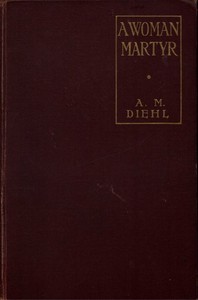
A Woman Martyr — Background and Themes
(0 User reviews)
365
Project Gutenberg
2012
Not confirmed
England -- Fiction; Man-woman relationships -- Fiction; Murder -- Fiction
Readers of public-domain and historical texts
Project Gutenberg digital edition
en
Edition facts
Words
61,858
Reading time
269 min
Text sections
9
Before opening A Woman Martyr — Background and Themes, the edition data offers a quick orientation: 61,858 words, 4 hr 29 min estimated reading time, and 9 detected text sections.
The text analysis averages about 17.9 words per sentence, while the detected sections provide another way to judge how the source is divided.
Project Gutenberg metadata also associates the work with “England -- Fiction,” connecting these edition facts with the source record’s subject description.
Source:
Project Gutenberg record #41711
Alice M. Diehl's 1903 novel uses a murder trial and a nightmare execution to probe the psychology of a woman caught between love, duty, and desperation, with vivid Hyde Park and theatrical settings.
Read the complete public-domain text at its original source.
Read on Project GutenbergThe novel opens in London's Hyde Park during a sharp shower, where a young woman on horseback, with a 'pale, classic face' and 'Venetian combination of dark brown eyes and red-gold hair,' anxiously scans the riders. Her internal conflict—between longing for Lord Vansittart and her own refusal of his offer—is rendered through physical gestures: biting her lip, a slight frown, and a 'wild, almost uncontrollable impulse' to speak to him. Diehl's prose dwells on the tension between outward composure and inner turmoil, a pattern that recurs throughout the excerpts.
Diction of Restraint and Intensity
Diehl's word choices oscillate between formal restraint and emotional intensity. In the opening scene, the heroine's feelings are described as 'dismay, mingled with involuntary ecstacy'—a precise pairing that captures conflicting states. Later, the nightmare sequence uses stark, physical language: 'strapping her with small leathern straps which hurt her,' and the dry reply, 'it will be over all the sooner.' The contrast between the polished society dialogue and the raw terror of the condemned cell is sharp. Diehl avoids melodramatic exclamation; instead, she lets the horror accumulate through matter-of-fact details, such as the tolling bell and the 'gleam of a white surplice.'
Voice and Dialogue: The Weight of Unspoken Words
Dialogue in the excerpts is sparse but loaded. The heroine's plea, 'oh, please don't,' is a fragile, childlike protest against the straps, while the executioner's dry response underscores the machinery of justice. In the trial scene, the judge's speech is formal and damning, using phrases like 'incontrovertible evidence of trustworthy witnesses' and 'your misguided and guilty life.' The heroine's own voice is often internal: she asks herself, 'Did he see me?' and later exclaims, 'You know, my God, I did not mean it!' These interior monologues reveal a character who is articulate in thought but often silenced in action, creating a tension between what is said and what is felt.
Structure: The Nightmare as Narrative Pivot
The most striking structural feature in the excerpts is the extended nightmare sequence, which occupies a full chapter. It begins with the trial and sentence, then shifts abruptly to the condemned cell, where the heroine is bound and led to execution. The awakening—'bathed in sweat from head to foot'—is a release, but the lingering fear that 'it might come true' anchors the novel's psychological stakes. This dream-within-a-narrative device allows Diehl to explore the heroine's guilt and fear without committing to a literal execution, and it mirrors the earlier scene of emotional paralysis in the park. The structure thus reinforces the theme of entrapment, both social and psychological.
Setting: Theatrical and Social Spaces
The excerpts move between three distinct settings: the public arena of Hyde Park, the private terror of the condemned cell, and the backstage world of the theatre. The park scene is meticulously observed—'sycamores and elms,' 'horse-chestnut tree,' 'equestrians in the Row'—and serves as a stage for social performance. In contrast, the theatrical setting in Chapter XX introduces Vera Anerley, an actress whose professional life involves 'fervour' and 'access of passion.' The backstage negotiations with the stage-manager and the dismissive attitude toward the dramatic critic hint at the compromises of artistic life. These settings are not mere backdrops but active forces that shape the characters' choices and constraints.
Diehl's novel rewards attention to the interplay between public facades and private fears. The excerpts suggest a narrative that moves between drawing-room decorum and the stark reality of the dock, using precise diction and controlled dialogue to build suspense. Readers may find particular interest in how the nightmare sequence functions as a compressed version of the plot's central anxieties, and how the theatrical subplot mirrors the theme of performance in everyday life.
I’ve often thought the trial in A Woman Martyr holds its breath the way we did waiting for verdicts in the old reading room. That same hush of moral reckoning seems to linger, somehow, inside Master of Men — Themes and Context, though its questions turn toward ambition rather than love. Two novels, one quiet kinship across the shelf.
There are no reviews for this eBook.
There are no comments for this eBook.
Reader reflection
How did this book work for you?
Your answers remain private and are stored only in this browser.
Your progress
0
/
10
2
How did the book work for you overall?
3
Is this a title you would suggest to others?
4
How demanding did the text feel?
5
Was the book easy to understand?
6
How strongly did the book affect you emotionally?
7
How did the reading compare with what you expected?
8
How closely did the book connect with your experience?
9
In one sentence, what did you learn?
10