1

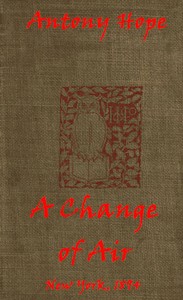
A Change of Air — Background and Themes
(0 User reviews)
296
Project Gutenberg
2014
Not confirmed
England -- Social life and customs -- 19th century -- Fiction; Country homes -- Fiction; Poets -- Fiction; Fame -- Fiction
Readers of public-domain and historical texts
Project Gutenberg digital edition
en
Edition facts
Words
60,936
Reading time
265 min
Text sections
7
The catalog record for A Change of Air — Background and Themes provides practical reading context through 60,936 words, 4 hr 25 min estimated reading time, and 7 detected text sections.
The text analysis averages about 13.2 words per sentence, while the detected sections provide another way to judge how the source is divided.
Project Gutenberg metadata also associates the work with “England -- Social life and customs -- 19th century -- Fiction,” connecting these edition facts with the source record’s subject description.
Source:
Project Gutenberg record #45749
Anthony Hope's 1894 novel traces poet Dale Bannister's retreat from London fame to rural Littlehill, where his arrival disrupts local society. The narrative moves between country drawing-rooms and London flats, using recurring images of birds, cages, and theatrical performance to examine the constraints of reputation and the gap between public persona and private self.
Read the complete public-domain text at its original source.
Read on Project GutenbergFrom its opening chapter, 'A Mission to the Heathen,' Anthony Hope's A Change of Air establishes a pattern of movement between worlds—London literary circles and the country society of Denborough, public performance and private retreat. The novel's structure alternates between these settings, each scene shift carrying the weight of social expectation and personal reinvention. Hope repeatedly frames his characters as performers: Dale Bannister, the celebrated poet, arrives at Littlehill as a 'new man' whose reputation precedes him, while the local gentry, led by the Squire and Mrs. Delane, stage their own rituals of calling and judgment. The narrative eye lingers on thresholds—doorways, windows, the edge of a room—where characters pause before entering or exiting, as if the novel itself is conscious of the boundaries between acts.
The Stagecraft of Social Entry
Hope choreographs his scenes with a theatrical attention to entrances and exits. When Dale Bannister first appears at Littlehill, the chapter title 'The New Man at Littlehill' signals a character stepping onto a new stage. The Squire's household deliberates over whether to call on him, treating the visit as a formal performance of social approval. Later, Mrs. Delane 'swept out of the room' after delivering her warning about Dale's influence on her daughter, her exit a curtain line. Even the Doctor's flight to London in Chapter XV is described as an 'expedition' driven by the need for an audience—'the desire for sympathy' and 'the comfort of an approving voice.' These movements are never casual; each departure or arrival recalibrates the social dynamics.
Birds, Cages, and the Language of Confinement
The novel's imagery clusters around birds and cages, suggesting both the allure and the trap of fame. Chapter XI is titled 'A Fable About Birds,' and the metaphor recurs: characters are described as caged, fluttering, or seeking escape. The Squire, reflecting on Dale's social rise, thinks that 'brains opened every front door'—but the open door is also a cage door, admitting the outsider into a gilded prison of expectation. Mrs. Delane's match-making is framed as putting someone 'in' or 'out' of a head, as if minds were aviaries. Even the Doctor's London flat, where Arthur Angell 'cultivated the Muses,' is a 'little flat at the top of a tall building'—a perch that is both elevated and isolated. The bird imagery never resolves into freedom; it remains a tension between flight and captivity.
The Divided Self: Public Poet vs. Private Man
Hope repeatedly splits his protagonist into competing selves. The Squire muses that Dale has 'done and said, or at least said he had done, or would like to do' wild things—a triple hedge that exposes the gap between action, speech, and desire. The Doctor, in his London exile, seeks someone who will 'share his anger and appreciate his meditated revenge,' revealing that even righteous indignation is a performance requiring an audience. The novel's chapter titles themselves enact this division: 'The Responsibilities of Genius' sits alongside 'Dale's Own Opinion,' as if the public role and private thought are separate entities. Hope never lets the reader forget that the poet is also a man who jingles money in his pocket and frowns at social slights.
The Rhythm of Repetition and Variation
Hope structures his narrative through repeated situations that accrue new meaning. The act of 'calling' recurs: Denborough determines to call on the new poet; later, the poet himself becomes the one who must call on others. The Squire's study serves as a recurring space for deliberation, where he walks about 'jangling the money in his pocket'—a gesture that appears twice in the excerpts, linking his economic and social calculations. Even the Doctor's journey to London mirrors Dale's earlier departure from the city, creating a chiasmic pattern of flight and return. These repetitions are not mere filler; they form a structural echo chamber where each iteration deepens the novel's meditation on how people perform their lives for others.
Readers attentive to the novel's spatial and imagistic patterns will find a work less concerned with plot twists than with the quiet violence of social positioning. Hope's sentences move with the same deliberate pacing as his characters—pausing, observing, then shifting to a new scene. The bird imagery and theatrical entrances reward careful attention; they are not decorative but structural, holding the novel's critique of fame and authenticity in place. Approach A Change of Air as a series of framed scenes rather than a linear story, and its subtle architecture becomes visible.
I’ve always remembered how A Change of Air lingers on the bird in the gilded cage, that quiet ache between freedom and display. It reminds me of another volume, The Morning Glory Club — Reading Notes, which holds a similar watchful sorrow about rooms where people perform themselves. They sit well together on a shelf, old friends sharing one unspoken knowing.
There are no reviews for this eBook.
There are no comments for this eBook.
Reader reflection
Before you leave, reflect on the book
Use these questions to collect your thoughts before moving on.
Your progress
0
/
10
2
How did the book work for you overall?
3
Would you recommend this book to another reader?
4
Did the language feel accessible?
5
Did the book meet your expectations?
6
Would you start a conversation about this book?
7
Is this a title worth rereading?
8
How distinctive were its ideas or approach?
9
What changed or sharpened your thinking?
10