1

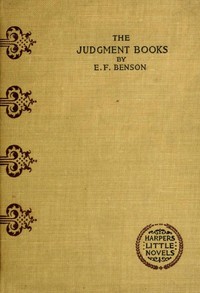
The Judgment Books: A Story — Context and Discussion
(0 User reviews)
619
Project Gutenberg
2014
Not confirmed
Artists -- Fiction; Paranormal fiction; Repentance -- Fiction; Husband and wife -- Fiction
Readers of public-domain and historical texts
Project Gutenberg digital edition
en
Edition facts
Words
27,719
Reading time
121 min
Text sections
3
The source record for The Judgment Books: A Story — Context and Discussion measures this digital text at 27,719 words, 2 hr 1 min estimated reading time, and 3 detected text sections.
The text analysis averages about 15.8 words per sentence, while the detected sections provide another way to judge how the source is divided.
Project Gutenberg metadata also associates the work with “Artists -- Fiction,” connecting these edition facts with the source record’s subject description.
Source:
Project Gutenberg record #46077
E. F. Benson's 1895 novel follows artist Frank Trevor, whose portrait of his own worst self becomes a supernatural conduit for guilt and obsession. The narrative hinges on the tension between artistic creation and moral decay, rendered through precise descriptions of Cornish landscape and psychological interiority.
Read the complete public-domain text at its original source.
Read on Project GutenbergThe opening pages of The Judgment Books establish a deceptively tranquil Cornwall setting: a terrace basking in September sun, bees moving with "unproverbial drowsiness," and a neglected tennis-ball in the gutter. This languid atmosphere is punctured by the arrival of Frank Trevor, an artist who has just completed a portrait that seems to drain his vitality. Benson's prose shifts between the idyllic and the ominous, as when Frank's friend Jack Armitage observes that the portrait "looked at him with a horrible familiarity." The novel's central conceit—that a painting can absorb its creator's soul—is introduced through careful, incremental details rather than overt supernatural declaration.
Diction of Decay and Obsession
Benson's word choices consistently blur the boundary between the physical and the psychological. The portrait is described as having "long-fingered hands" that "smoothed out its creases with a lingering, loving touch," attributing agency to the painted figure. Verbs like "crept," "flowed," and "entered" suggest a slow invasion: Frank's "past life flowed higher and higher round him" as he works. The narrator notes that "the devil is a highwayman who waits for men who are alone," a simile that grounds the supernatural in criminal imagery. Even the landscape participates in this decay: the iron staircase is "fringed with oozy, amphibious growth," and the estuary water "crept up silently." These choices create a world where deterioration is both natural and menacing.
Dialogue as Revelation of Fear
Conversations in the excerpts are sparse but charged. When Margery insists Frank must face his fear, she says, "Oh, Frank, don't be a fool!"—a blunt dismissal that contrasts with his childlike plea: "Margery, you will come back to-morrow, won't you?" Her determination to "cure him" by forcing him to "give himself absolute final evidence" reveals a rationalist approach that underestimates the irrational. Frank's unspoken fear—that losing Margery is worse than losing himself—is never articulated aloud, making his later isolation more poignant. The dialogue thus functions as a mask: what is said contradicts what is felt, and the reader must infer the terror beneath the surface.
Structure of Suspense and Isolation
Benson builds tension through a deliberate pacing of action and reflection. The first chapter lingers on Jack's drowsy meditation, then shifts abruptly to Frank's frantic work after Margery departs. The narrative alternates between external description (the tennis-court, the beehives) and internal dread, creating a rhythm of calm and crisis. Frank's two-day painting marathon is rendered in compressed time: "he worked alone, as he had never worked before, but as he has often worked since." This temporal leap—from a specific past to a habitual present—hints at a pattern of obsession beyond the immediate story. The structure mirrors the portrait's own process: slow accumulation of detail, then a sudden, irreversible completion.
Recurring Motifs of Reflection and Doubling
The portrait functions as a doppelgänger, but Benson avoids cliché by emphasizing the act of looking. Frank's "worst self" smiles at a "yellow little programme," a mundane object that becomes sinister through repetition. The motif of reflection extends to the landscape: the estuary mirrors the sky, the bees mirror human drowsiness. When Frank feels his "conscious self seemed to be passing into the portrait," the boundary between creator and creation dissolves. The narrator's comment that "no man knows the best of himself, but only the worst" reframes the portrait as a confession of limitation. These recurring images of reflection and doubling give the novel a cohesive symbolic language without resorting to explicit explanation.
Readers attentive to Benson's craft will notice how the novel's supernatural premise is grounded in precise, sensory detail. The Cornish setting is not mere backdrop but an active participant in the mood of entrapment. Pay particular attention to the moments when characters observe themselves being observed—by portraits, by mirrors, by the silent estuary. These recursive glances are the novel's true engine, and they reward close reading.
Reading about Frank Trevor's portrait, I found myself thinking of that quieter, stranger book where night itself becomes a kind of canvas—not obsession, but waiting. There’s a shared hush between the Cornish cliffs and that doctor’s lamp-lit house. Both stories seem to know how rooms hold what we don’t say. The Doctor's Christmas Eve — A Reader’s Guide lingers in that same patient twilight.
There are no reviews for this eBook.
There are no comments for this eBook.
Reader reflection
Before you leave, reflect on the book
Use these questions to collect your thoughts before moving on.
Your progress
0
/
10
2
Was reading this book enjoyable?
3
Would you encourage someone else to read it?
4
What was the reading difficulty like?
5
How did the pace of the book feel?
6
Could you apply anything you learned?
7
Did the book meet your expectations?
8
How distinctive were its ideas or approach?
9
What is the main idea you are taking away?
10