1

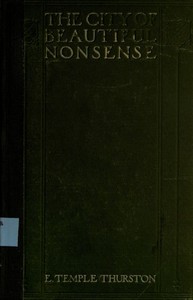
The city of beautiful nonsense — Text and Context
(0 User reviews)
2883
Project Gutenberg
2013
Not confirmed
Venice (Italy) -- Fiction; Authors -- Fiction; Man-woman relationships -- Fiction
Readers of public-domain and historical texts
Project Gutenberg digital edition
en
Edition facts
Words
87,868
Reading time
383 min
Text sections
12
Before opening The city of beautiful nonsense — Text and Context, the edition data offers a quick orientation: 87,868 words, 6 hr 23 min estimated reading time, and 12 detected text sections.
The text analysis averages about 15.0 words per sentence, while the detected sections provide another way to judge how the source is divided.
Project Gutenberg metadata also associates the work with “Venice (Italy) -- Fiction,” connecting these edition facts with the source record’s subject description.
Source:
Project Gutenberg record #41752
This editorial note examines the shifting narrative pace in Temple Thurston's novel, from the hushed, secret-laden opening in Lincoln's Inn Fields to the lyrical, immersive description of Venice. The voice oscillates between intimate observation and romantic reverie, with a recurring motif of 'secrets' and 'shadows' that shapes the story's atmosphere.
Read the complete public-domain text at its original source.
Read on Project GutenbergThe novel opens with a precise temporal marker—'the eighteenth of March'—only to immediately undermine it: 'it is out of the question to say upon which day of the week it fell.' This deliberate vagueness sets the tone for a narrative that prioritizes atmosphere over chronology. The prose in the first chapter is hushed and secretive, with houses that 'huddle together' and 'whisper' their secrets. The silence of Lincoln's Inn Fields is broken only by the footsteps of a lawyer's clerk, each step 'vibrated through the intense quiet.' This careful attention to sound and stillness establishes a slow, almost breathless pace that contrasts sharply with later passages.
The Rhythm of Secrets and Shadows
The opening chapters are dominated by a sense of withheld information. The narrator directly addresses the reader, confessing ignorance about St. Joseph's day and hinting at a 'fairy story' to come. The prose lingers on details—the 'curtain of shadows,' the 'sleepy children' simile—creating a languid, anticipatory rhythm. This is a voice that savors mystery, as seen in the repeated motif of secrets: houses have them, characters harbor them, and the narrative itself seems reluctant to reveal its hand. The pace is unhurried, almost meditative, inviting the reader to dwell in the uncertainty.
A Shift in Voice: From Whisper to Romance
When John describes Venice to Jill, the narrative voice undergoes a marked transformation. The clipped, observational tone of the London scenes gives way to a lyrical, almost incantatory style. John's speech is a set-piece of romantic description: 'a city of slender towers and white domes, sleeping in the water like a mass of water lilies.' The sentences grow longer, more rhythmic, and the imagery becomes lush and sensory—'dark water-ways, mysterious threads of shadow,' 'the plash of the gondolier's oar.' This shift is not merely a change in subject but a deliberate modulation of pace, from the constrained quiet of Fetter Lane to the expansive, dreamlike evocation of Venice.
The Interplay of Dialogue and Description
Thurston uses dialogue to control the narrative tempo. In the excerpt, Jill's questions—'What is she like?'—prompt John's extended reverie, which in turn slows the scene to a near-halt. The conversation becomes a vehicle for the novel's central tension: the pull between present duty and imagined future. The dialogue itself is marked by pauses and hesitations, as when Jill 'tried in one grasp of her mind to hold all that that meant.' These moments of introspection create a counterpoint to the descriptive passages, giving the narrative a breathing rhythm. The result is a voice that oscillates between intimate exchange and panoramic vision, never settling into a single register.
Readers attuned to shifts in narrative pace will find in The City of Beautiful Nonsense a work that moves between two poles: the constrained, secret-laden world of London and the expansive, romanticized Venice of John's imagination. The novel's voice is never static; it modulates with each scene, using silence and speech, shadow and light, to create a texture that rewards close attention to its cadences.
I keep thinking about that quiet chapter in Lincoln’s Inn Fields, how secrets hang there like held breath, and then Venice loosens everything into light. It reminded me of the slow way the Gulf unfolds in Gunboat and Gun-runner: A Tale of the Persian Gulf — Text and Context—same shadowed patience, urging nothing, just letting places breathe their own truth.
There are no reviews for this eBook.
There are no comments for this eBook.
Reader reflection
How did this book work for you?
Your answers remain private and are stored only in this browser.
Your progress
0
/
10
2
What was your overall reaction to the book?
3
Is this a title you would suggest to others?
4
How demanding did the text feel?
5
Could you apply anything you learned?
6
How well did it match your expectations?
7
How closely did the book connect with your experience?
8
How did the pace of the book feel?
9
What changed or sharpened your thinking?
10