1

Gunboat and Gun-runner: A Tale of the Persian Gulf — Text and Context
(0 User reviews)
3893
Project Gutenberg
2014
Not confirmed
Illegal arms transfers -- Fiction; Great Britain. Royal Navy -- Fiction; Persian Gulf -- Fiction
Readers of public-domain and historical texts
Project Gutenberg digital edition
en
Edition facts
Words
106,111
Reading time
462 min
Text sections
12
For Gunboat and Gun-runner: A Tale of the Persian Gulf — Text and Context, the stored edition analysis reports 106,111 words, 7 hr 42 min estimated reading time, and 12 detected text sections.
The text analysis averages about 20.4 words per sentence, while the detected sections provide another way to judge how the source is divided.
Project Gutenberg metadata also associates the work with “Illegal arms transfers -- Fiction,” connecting these edition facts with the source record’s subject description.
Source:
Project Gutenberg record #46460
A lieutenant's firsthand account of Royal Navy patrols intercepting arms-smuggling dhows in the Persian Gulf, structured around tense night ambushes, coastal landings, and the precarious authority of a small armed launch.
Read the complete public-domain text at its original source.
Read on Project GutenbergThe narrative of Gunboat and Gun-runner moves between the cramped deck of the armed launch Bunder Abbas and the rocky, moonlit paths of the Baluch coast. The story is built around a series of patrols, boardings, and ambushes, each scene defined by the physical constraints of the setting—the narrow beam of a dhow, the steep descent of a mountain pass, the limited visibility of a starlit night. The author, a Royal Navy surgeon, draws on firsthand accounts to render these operations with a focus on procedural detail: how a search party is organized, how a dhow is approached, how a landing party communicates in the dark. The result is a work less concerned with grand strategy than with the immediate, sensory experience of small-boat work in a contested littoral.
The Launch as a Floating Stage
The Bunder Abbas is not merely a vessel but a mobile base of operations, and Jeans repeatedly emphasizes its limitations. The launch is small, lightly armed, and dependent on coal; its crew lives in close quarters, and its authority rests on the threat of force rather than overwhelming firepower. The narrative lingers on the practicalities of life aboard: the watchkeeping, the stowage of gear, the constant need for fresh water. When the launch intercepts a dhow, the action is described from the perspective of the deck—the hail, the approach, the boarding party climbing over the gunwale. This confined viewpoint gives the story a documentary quality, as if the reader is standing beside the narrator, peering into the darkness.
Night Operations and the Limits of Sight
Several key episodes occur in near-total darkness, and Jeans makes the most of restricted visibility. During the ambush in the mountain pass, the narrator and his companion Webster can only track the Arab scout Jaffa by the white of his clothing, losing sight of him when he moves too far down the path. The tension of the scene depends on what cannot be seen: the unseen Bedouin below, the unseen match that Jaffa threatens to strike, the unseen rifles that might be raised. Later, when a rifle accidentally discharges, the confusion is immediate and dangerous—the darkness turns a mistake into a crisis. Jeans uses these moments to show how naval discipline and rehearsed phrases (the Arabic commands repeated until they become automatic) are fragile in the face of darkness and uncertainty.
The Recurring Image of the Dhow
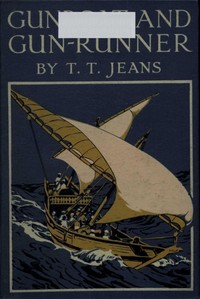
Dhows appear throughout the text as both quarry and symbol. They are described with a sailor's eye for rig and hull: lateen sails, wooden hulls, cargo holds packed with rifles. The frontispiece illustration shows the Bunder Abbas coming upon a dhow in the act of landing guns, and the narrative returns to this image again and again—a low, dark shape on the water, a sudden flurry of activity on the beach, the race to intercept before the cargo is unloaded. The dhow is not exoticized; it is a working vessel, and the men who sail it are described as capable and determined. The cat-and-mouse game between launch and dhow gives the story its basic rhythm: pursuit, boarding, search, and often disappointment when the arms have already been moved inland.
Movement Between Sea and Shore
The structure of the book alternates between shipboard scenes and land-based operations, and Jeans pays careful attention to the logistics of moving between the two. A landing party must row ashore in a cutter, haul the boat up a beach, and then proceed on foot, often at night, over unfamiliar ground. The terrain is consistently difficult: loose stones, steep paths, the risk of ambush. The narrator’s anxiety about being cut off from the launch is a recurring note. In the mountain pass episode, the party is stranded on a ledge, unable to descend until dawn, and the sense of isolation is palpable. These transitions—from deck to beach, from beach to hill—are where the story’s tension is highest, because the characters are most vulnerable.
Readers should approach this book as a work of operational realism rather than adventure fiction. The author’s preface states that the incidents are based on actual occurrences and were reviewed by officers who served in the gun-running patrols. The narrative’s strength lies in its attention to the mundane details of patrol work—the waiting, the false alarms, the accidental discharge that nearly derails a carefully planned operation. Those interested in the history of the Royal Navy’s role in the Persian Gulf, or in the mechanics of small-boat interdiction, will find this a valuable firsthand account.
That old lieutenant’s quiet tension on the dark water reminded me of something else—the way Pabo, the Priest sits with you long after the last page, not loud, just present. Pabo, the Priest: A Novel — Reading Notes has that same unhurried weight, like a held breath you don’t notice until it’s gone.
There are no reviews for this eBook.
There are no comments for this eBook.
Reader reflection
What was your reading experience?
Capture what you thought, learned, and would like to remember.
Your progress
0
/
10
2
What was your overall reaction to the book?
3
Is this a title you would suggest to others?
4
How much effort did this book require?
5
Would you like to discuss this book with someone?
6
Was the book moving at the right speed?
7
Which part made the strongest impression?
8
How did the reading compare with what you expected?
9
In one sentence, what did you learn?
10