1

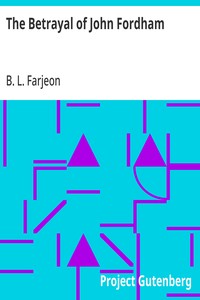
The Betrayal of John Fordham — Edition Insights
(0 User reviews)
1604
Project Gutenberg
2014
Not confirmed
Alcoholics -- Fiction; Murder -- Fiction; Husband and wife -- Fiction
Readers of public-domain and historical texts
Project Gutenberg digital edition
en
Edition facts
Words
101,865
Reading time
443 min
Text sections
9
Before opening The Betrayal of John Fordham — Edition Insights, the edition data offers a quick orientation: 101,865 words, 7 hr 23 min estimated reading time, and 9 detected text sections.
The text analysis averages about 15.1 words per sentence, while the detected sections provide another way to judge how the source is divided.
Project Gutenberg metadata also associates the work with “Alcoholics -- Fiction,” connecting these edition facts with the source record’s subject description.
Source:
Project Gutenberg record #45525
John Fordham, a self-confessed murderer, writes a confession claiming he killed a man in self-defense but cannot remember the victim's face or the events of that night. His narrative weaves between his present torment and his past in Australia, where a gold discovery and a letter from home set him on a path to tragedy.
Read the complete public-domain text at its original source.
Read on Project GutenbergJohn Fordham opens his confession with a stark declaration: he is a murderer, though he insists the killing was done in self-defense and that he cannot recall the face of his victim. The narrative immediately establishes a tension between his claim of sound mind and the “black cloud” that obscures the crucial night. Fordham’s voice is urgent, pleading, and laced with self-awareness of how his protestations will be received—a man who knows he sounds guilty. The opening chapter, titled “John Fordham’s Confession,” frames the entire novel as a first-person account, inviting readers to weigh his words against the damning evidence he mentions.
The Confession as Frame
The novel begins not with a crime scene but with a written confession, a device that shapes how readers encounter the story. Fordham addresses an unnamed audience, anticipating their disbelief: “My protestations will be regarded as weak inventions.” This self-consciousness colors every subsequent revelation. The confession is dated two years after the murder, and Fordham describes his present state—sleepless nights, “frightful images,” and a torturer who visits daily. The reader is placed in the position of judge, asked to sift truth from a narrator who admits his memory is flawed. The opening chapter thus establishes a central question: can a man who cannot remember killing be believed?
A Past in the Goldfields
Fordham’s narrative shifts to his three years in Australia, where he prospected for gold. The excerpts describe a specific episode: he finds a quartz boulder with fine gold specks, but the discovery is “valueless” without machinery. Six months later, others have claimed the reef, and the boulder is blasted away. Fordham’s tone is resigned: “Hundreds of other men on the goldfields have missed fortune in the same manner.” This passage grounds the story in concrete detail—the quartz, the stamping machine, the “pocket” of gold later found in a worked-out shaft. The goldfields serve as a backdrop of hard luck and fleeting opportunity, leading to the letter that changes his life.
The Letter That Changes Everything
Fordham’s decision to return to England is triggered by a mail delivery. He describes walking to a neighboring township in the middle of the night, joining “scores of bearded men” clustered at a wooden building. The scene is vivid and specific: the anxious crowd, the little window. The letter itself is not quoted, but its effect is immediate—it “changed the current of my life and led to the unconscious committal of the crime.” The reader is left to infer its contents from Fordham’s earlier mention of Ellen and his boy, and from his fear that his presence in London might disturb “the life of peace which Ellen was enjoying.” The narrative withholds the letter’s text, creating suspense around what news could provoke such a fatal turn.
The Unseen Victim
Throughout the excerpts, the murder victim remains unnamed and undescribed. Fordham states he did not see the man’s features and did not know who he was. This absence is striking: the crime at the story’s center is defined by what the narrator cannot see or remember. The “damning evidence” found afterward is mentioned but not detailed. The reader is left to wonder what that evidence might be—a weapon, a bloodstained item, a witness? Fordham’s insistence on self-defense, coupled with his amnesia, creates a puzzle that the confession itself cannot solve. The novel’s structure, moving between past and present, keeps the identity of the victim and the truth of that night as the central unknowns.
Readers approaching The Betrayal of John Fordham should attend to the gaps in Fordham’s memory and the details he chooses to include. His confession is both a plea and a puzzle, and the excerpts suggest that the goldfields narrative may hold clues to the events in London. The novel’s first-person voice demands scrutiny: Fordham is the only source, and his reliability is openly questioned. Pay attention to the recurring motif of darkness and obscured vision—the “black cloud,” the unseen victim—as it may signal how the story asks to be read.
Reading about John Fordham’s fractured memory—that blank space where a face should be—brought back the misty corridors of another old story, where identity itself proves slippery and the past refuses to stay buried. Both have that particular ache of a truth half-seen. It’s the kind of book that lingers at the edge of thought. The Hunchback of Westminster — Inside the Classic felt like the same lamp flickering in a different, older window.
There are no reviews for this eBook.
There are no comments for this eBook.
Reader reflection
Before you leave, reflect on the book
Use these questions to collect your thoughts before moving on.
Your progress
0
/
10
2
How did the book work for you overall?
3
Would you recommend this book to another reader?
4
How much effort did this book require?
5
Which element worked best for you?
6
How strongly did the book affect you emotionally?
7
Would you like to discuss this book with someone?
8
How distinctive were its ideas or approach?
9
In one sentence, what did you learn?
10