1

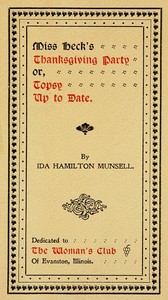
Miss Heck's Thanksgiving Party; or, Topsy Up To Date — Themes and Context
(0 User reviews)
528
Project Gutenberg
2013
Not confirmed
African American women -- Fiction; Household employees -- Fiction; Thanksgiving Day -- Fiction
Readers of public-domain and historical texts
Project Gutenberg digital edition
en
Edition facts
Words
5,795
Reading time
26 min
Text sections
1
The source record for Miss Heck's Thanksgiving Party; or, Topsy Up To Date — Themes and Context measures this digital text at 5,795 words, 26 min estimated reading time, and 1 detected text section.
The text analysis averages about 26.2 words per sentence, while the detected sections provide another way to judge how the source is divided.
Project Gutenberg metadata also associates the work with “African American women -- Fiction,” connecting these edition facts with the source record’s subject description.
Source:
Project Gutenberg record #44319
Ida Hamilton Munsell's 1895 satire follows Miss Myra Heck, a Black maid-of-all-work in Rexville who outmaneuvers her white employers through wit and audacity, culminating in a Thanksgiving party where borrowed finery exposes social hypocrisies.
Read the complete public-domain text at its original source.
Read on Project GutenbergThe opening pages of Ida Hamilton Munsell's 1895 novella immediately establish a satirical voice that refuses to sentimentalize its protagonist. Miss Myra Heck is introduced not as a pitiable figure but as a woman of 'really uncommon talents' whose 'brain teems at all times with schemes worthy of a French diplomat.' The narrator's arch tone—lamenting that novelists 'show such decided preferences for white-skinned heroines'—signals a knowing critique of literary conventions. Set in the fictional town of Rexville, where servants are scarce and mistresses desperate, the story presents a domestic power reversal: Miss Heck 'rules the mistresses of Rexville with a rod of iron.' The title's reference to Topsy from Uncle Tom's Cabin frames this as an updated, irreverent portrait of a Black woman navigating post-Reconstruction social hierarchies.
A Narrator Who Winks at the Reader
The narrator of Miss Heck's Thanksgiving Party adopts a conspiratorial, ironic stance that undercuts any pretense of moral earnestness. From the first paragraph, the reader is told that Miss Heck would have achieved 'world-wide renown' were she not born 'of black parents away down in the sunny southland.' The phrasing—'unfortunately' repeated twice—mimics the language of racial apology while actually exposing the absurdity of such prejudice. This double-voiced narration continues throughout: Miss Heck's 'ugly habit of prevaricating' and her 'too confident disposition to presume' are listed alongside her genuine abilities, leaving the reader to decide where sympathy lies. The narrator never fully condemns or praises, instead inviting a knowing chuckle at the expense of Rexville's flustered ladies.
The Economics of Domestic Service
Munsell grounds her comedy in the material realities of household labor. Rexville suffers from a 'scarcity of help,' which gives Miss Heck extraordinary leverage. She 'oscillates' between employers, confident that if one family dismisses her, 'she is sure of a position with some other lady on the street before twenty-four hours shall have sped.' The story hinges on the Thanksgiving party, for which Miss Heck borrows—without permission—her employer's silks and satins. The banker's wife only learns of the party 'at least a year after the occurrence,' by which time Miss Heck has moved to the parsonage. This timeline underscores the transient, transactional nature of domestic work: loyalty is fleeting, and memory is selective. The narrator's dry observation that Miss Heck's 'impartiality is sublime' turns a vice into a wry virtue.
Religious Authority and Its Limits
The final pages introduce a new employer: the minister of the parsonage, who attempts to convert 'this Topsy (up to date) from the error of her ways.' The narrator notes that his efforts 'had not met with that measure of success which usually have crowned his ministrations.' Miss Heck remains 'a rather difficult subject,' and the story ends with her still reigning over Rexville's mistresses. This anticlimax is deliberate: religious redemption is offered but refused, or at least deferred. The minister's project—'to pluck one more brand from the burning'—is framed as a conventional piety that fails against Miss Heck's pragmatic self-interest. The novella thus resists the expected moral arc, leaving its protagonist unrepentant and in control.
Readers should approach this text as a layered satire that rewards attention to its narrative voice. The novella's brevity—under 6,000 words—belies its complexity: every ironic aside and structural choice contributes to a portrait of a woman who exploits the very system that marginalizes her. Pay particular attention to how Munsell uses the Thanksgiving setting not as a backdrop for gratitude but as a stage for social performance and borrowed authority. The story's 1895 publication date places it within ongoing debates about race, gender, and labor in the post-Reconstruction United States.
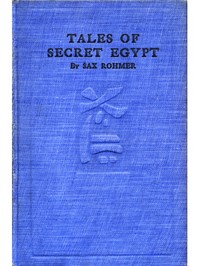
Sometimes a story stays with you less for its plot than for how it peels back polite surfaces. That old satire about Miss Heck made me think of quiet evenings with Tales of Secret Egypt — Themes and Context, where every shadow feels like it’s hiding another layer of knowing. Both left me feeling tenderly suspicious of what people choose to show each other.
There are no reviews for this eBook.
There are no comments for this eBook.
Reader reflection
Before you leave, reflect on the book
Use these questions to collect your thoughts before moving on.
Your progress
0
/
10
2
How much did you enjoy the reading experience?
3
Is this a title you would suggest to others?
4
How demanding did the text feel?
5
Which part made the strongest impression?
6
Would this book work well in a reading group?
7
Do you expect to return to this book?
8
Did this book create an emotional response?
9
In one sentence, what did you learn?
10