1

Friar Tuck Being the Chronicles of the Reverend John Carmichael, of Wyoming, U. S. A. — A Closer Reading
(0 User reviews)
1713
Project Gutenberg
2013
Not confirmed
Western stories; Clergy -- Fiction; Wyoming -- Fiction
Readers of public-domain and historical texts
Project Gutenberg digital edition
en
Edition facts
Words
149,022
Reading time
648 min
Text sections
12
The catalog record for Friar Tuck Being the Chronicles of the Reverend John Carmichael, of Wyoming, U. S. A. — A Closer Reading provides practical reading context through 149,022 words, 10 hr 48 min estimated reading time, and 12 detected text sections.
The text analysis averages about 23.4 words per sentence, while the detected sections provide another way to judge how the source is divided.
Project Gutenberg metadata also associates the work with “Western stories,” connecting these edition facts with the source record’s subject description.
Source:
Project Gutenberg record #41926
An editorial note on the oral storytelling structure, recurring imagery of dogs and horses, and movement between campfire intimacy and frontier action in Robert Alexander Wason's 1912 novel about a Wyoming clergyman.
Read the complete public-domain text at its original source.
Read on Project GutenbergThe author's prefatory address to readers who feel 'the call of the open road' and recognize a fraternity 'always recognized by dogs and horses' establishes a key structural principle: the novel is meant to be heard, not read. Wason explicitly warns that the story is 'told, rather than written,' and asks the reader to supply the atmosphere of night camps and winter evenings where a rider shifts his weight and speaks from the heart. This frame positions the narrative as a series of oral performances, with the text serving as a script for imagined voices.
A Told Story in Print
The opening note insists that the book defies 'the formal technique of literary construction' and turns to 'the more elastic methods of Nature.' This is not mere modesty: the prose bears out the claim. Sentences run long, punctuated by dashes and colloquial rhythm: 'He shot his hand across an’ pulled his gun quick as a flash; but Horace didn’t move, he just sat still, with a friendly smile on his face.' The narrator, Happy Hawkins, uses a vernacular that shifts between past-tense narration and direct dialogue, often blending the two. The effect is that of a man spinning a yarn by a fire, where the listener's imagination must supply the twinkle of the eye or the accent that gives a word its sting.
Recurring Images: Dogs, Horses, and the Open
Two animal motifs recur with structural regularity. Dogs appear as creatures of literal instinct—'Dogs haven’t enough imagination to work on,' says Horace—while horses are linked to freedom and the fraternity of the road. The dedication speaks of an emblem 'hidden behind deep and steadfast eyes' that is 'always recognized by dogs and horses,' suggesting a code of character legible only to the non-human. In the excerpt, the arrival of Olaf and Kit Murray is announced by a whistle and the release of ponies; the corral becomes a threshold between domestic safety and the wild. These images anchor the story's movement between enclosed spaces (the cabin, the corral) and the unbounded landscape beyond.
Movement Between Intimacy and Action
The narrative oscillates between quiet, reflective moments and sudden bursts of action. In the excerpt, a long evening of storytelling—'Greek-hero tales' that 'blistered the imagination'—is broken by a noise at the corral, and the group shifts instantly from relaxed yarn-spinning to armed alertness. This pattern mirrors the author's stated ideal: the 'mad gallop out beyond speed limits and grass signs' alternating with the 'delightful moments of relaxation when the restraint of self-consciousness is dropped.' The structure is episodic, built around campfire scenes that frame the action, rather than a continuous plot. Each episode typically begins with a group gathered in a domestic space, then moves outward into conflict or rescue.
Voice and the Framing Narrator
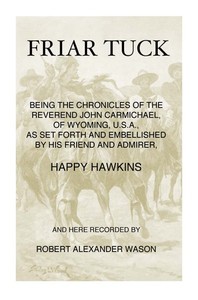
The story is filtered through Happy Hawkins, a first-person narrator who is both participant and observer. His voice carries a wry, self-deprecating humor: 'We let Horace sit there the whole evenin’, tellin’ Greek-hero tales which must have blistered the imagination o’ the feller ’at first made ’em up.' He often undercuts his own companions with affectionate irony. This narrative distance allows the reader to enjoy the tall tales while remaining aware of their exaggeration. The frame is reinforced by the book's subtitle—'as set forth and embellished by his friend and admirer Happy Hawkins'—which reminds us that we are reading a secondhand account, embellished for effect. The result is a layered storytelling that prioritizes voice over verisimilitude.
Setting as Character
Wyoming is not merely a backdrop but an active force in the narrative. The landscape is evoked through sensory details: the 'still cold' at the threshold, the blizzard howling 'around the log corners,' the 'night camps with the pipes sending up incense about the tiny fires.' The homestead in the excerpt is described as having 'only two rooms, countin’ the lean-to kitchen,' and the characters are acutely aware of its vulnerability. The setting shapes the plot—the need to hold the place against 'Cross-branders' drives the action—and also the characters' psychology. Kit Murray's transformation from recklessness to a 'quiet, holy look' is tied to her decision to settle on this hard land. The environment is never merely scenic; it is a participant in the story's conflicts.
Readers should approach Friar Tuck as a performance text, best enjoyed aloud or with an ear for the rhythms of oral storytelling. The novel's episodic structure rewards attention to the framing voice of Happy Hawkins, whose commentary often undercuts or amplifies the events he describes. The recurring animal imagery and the movement between intimate campfire scenes and frontier action provide a coherent structure beneath the seemingly loose narrative. This is a book that asks to be listened to, not analyzed for plot consistency.
Folks forget how a frontier parson’s yarns, spun ’round embers with a dog at his boots, carry the same unhurried trust as those old union talks in Friar Tuck. There’s a kinship between any voice that holds a circle still—whether preaching or bargaining. I’ve kept both on my shelf, and they whisper to each other: The Walking Delegate — Reading Notes listens closely, like a friend finishing a sentence you started years ago.
There are no reviews for this eBook.
There are no comments for this eBook.
Reader reflection
How will you remember this book?
Save your reaction, strongest insight, and memorable passage.
Your progress
0
/
10
2
Was reading this book enjoyable?
3
Would you recommend this book to another reader?
4
How easy was the book to follow?
5
How much did the book move you?
6
Would you like to discuss this book with someone?
7
Would a second reading be valuable?
8
Which aspect of the book did you value most?
9
What changed or sharpened your thinking?
10