1

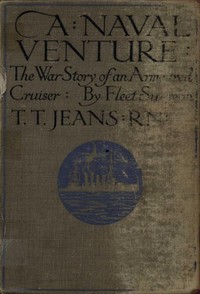
A Naval Venture: The War Story of an Armoured Cruiser — Story, Setting & Ideas
(0 User reviews)
800
Project Gutenberg
2014
Not confirmed
Great Britain. Royal Navy -- Fiction; World War, 1914-1918 -- Naval operations -- Fiction; World War, 1914-1918 -- Campaigns -- Turkey -- Gallipoli Peninsula -- Fiction
Readers of public-domain and historical texts
Project Gutenberg digital edition
en
Edition facts
Words
128,960
Reading time
561 min
Text sections
16
For A Naval Venture: The War Story of an Armoured Cruiser — Story, Setting & Ideas, the stored edition analysis reports 128,960 words, 9 hr 21 min estimated reading time, and 16 detected text sections.
The text analysis averages about 21.1 words per sentence, while the detected sections provide another way to judge how the source is divided.
Project Gutenberg metadata also associates the work with “Great Britain. Royal Navy -- Fiction,” connecting these edition facts with the source record’s subject description.
Source:
Project Gutenberg record #45960
A naval tale of the Dardanelles campaign, following the crew of the armoured cruiser Achates through bombardments, submarine threats, and shore landings, with a focus on gun-room life and the shifting moods between action and uneasy calm.
Read the complete public-domain text at its original source.
Read on Project GutenbergThe story opens on a wet February afternoon in 1915, with the picket-boat of H.M.S. Achates lying alongside the King's Stairs at Portsmouth Dockyard. The rain streams down oilskins, and dark clouds scud overhead from Gosport, signalling a gale in the Channel. This precise, weather-conscious beginning establishes a pattern: the narrative repeatedly uses atmospheric conditions—sun, sea, wind—to frame shifts between tension and respite. The author, Fleet-Surgeon T. T. Jeans, draws on his own service and the accounts of shipmates to construct a story that moves from the gun-room to bombardment lines, from night adventures to the beaches of Gallipoli.
Structure: From Portsmouth to the Dardanelles
The book is organised as a chronological sequence of episodes, each chapter titled like a log entry: “The ‘Achates’ goes to Sea,” “Ordered to the Mediterranean,” “The Bombardment of Smyrna Forts.” This structure mirrors the incremental nature of naval operations during the campaign. The narrative does not follow a single arc but accumulates incidents—a night attack, a landing, a submarine scare—giving the reader a sense of the piecemeal, often waiting-filled experience of the crew. The preface acknowledges that many incidents came from other officers and men, which may explain the episodic texture: the story is assembled from multiple viewpoints rather than a single protagonist’s journey.
Recurring Images: Weather and Water as Mood-Setters
Weather is not mere backdrop but a recurring device that signals the emotional temperature. The opening rain and gale give way to a “grand day” with “the sun shining out of an almost cloudless sky, the sea bluer than the sky” when the Achates sails for Mytilene. Later, after submarines sink the Triumph and Majestic, the narrative describes “two bright patches of cheerful sky between the dark clouds.” These meteorological contrasts punctuate the story, marking transitions from danger to relative safety. The sea itself is described with precision—ruffled by a breeze, or ominously calm—and the ship’s movement through it, zigzagging to avoid submarines, becomes a repeated choreography of survival.
Movement Between Scenes: Ship, Shore, and the Spaces Between
The narrative moves fluidly between the confined world of the gun-room and the exposed beaches of Gallipoli. A chapter titled “The Beach Party” and another “In ‘Dug-outs’ at Cape Helles” show the crew shifting from shipboard routine to shore operations. The author uses small craft—picket-boats, trawlers, fleet sweepers—as connectors, emphasising the logistical backbone of the campaign. One striking transition occurs when the Achates leaves Mudros for Mytilene, described as a passage “through a narrow channel between tree-clad heights” into a land-locked harbour. These movements are not merely geographical; they mark changes in threat level, from the open sea’s submarine danger to the relative shelter of an anchorage.
Voice and Dialogue: The Gun-Room Vernacular
The dialogue carries a distinct naval flavour, with commands and casual speech blending. An early line—“Aim low, sonny! Aim low. You will see your bullet-splashes”—captures the terse, practical instruction of experienced men. Elsewhere, a captain’s reply to a worried doctor—“He is quite cheery; he has a lot ‘up his sleeve’ yet”—reveals the deliberate optimism maintained in the face of losses. The gun-room court martial on the China doll (listed in the illustrations) hints at the lighter, ritualistic side of shipboard life. These voices ground the story in a specific community, where rank and role shape every exchange, and where humour and tension coexist in the same breath.
Readers should approach A Naval Venture as a composite portrait rather than a novel with a tight plot. The episodic structure rewards attention to the shifts in setting and mood, which the author uses to convey the rhythm of waiting, action, and aftermath. The weather, the sea, and the constant movement between ship and shore are not decoration but the story’s organising principles. This is a book best read for its texture—the feel of a wet deck, the sight of a periscope, the sound of a captain’s steady voice—rather than for a single dramatic arc.
Sometimes, when the guns fall silent in A Naval Venture, I think of another quiet patience found in The Lost Cabin Mine — Background and Themes. Both share that long waiting—the crew’s uneasy calm before action, the prospector’s hunch before the strike. It’s that same held breath, the world suspended between what is and what might be.
There are no reviews for this eBook.
There are no comments for this eBook.
Reader reflection
What was your reading experience?
Capture what you thought, learned, and would like to remember.
Your progress
0
/
10
2
Was reading this book enjoyable?
3
Would you recommend this book to another reader?
4
Did the language feel accessible?
5
How would you describe its reading pace?
6
Did the book give you something worth debating?
7
How did the reading compare with what you expected?
8
Did any part of the book stay with you emotionally?
9
What did this book teach you most?
10