
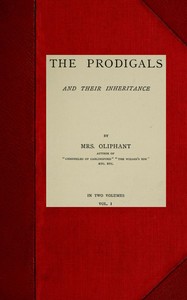
The Prodigals and Their Inheritance; vol. 1 by Mrs. Oliphant
Let's talk about what actually happens in this book. Mrs. Oliphant sets the stage with the Molyneux family. The father has lived a comfortable, somewhat careless life, and when he dies, his sons Frank and Edmund are left with almost nothing. Their only hope is their uncle, a wealthy but miserly man named Colonel Sutherland, who might—or might not—leave them his fortune. With this shaky promise hanging over them, the brothers are thrust into the world to fend for themselves.
The Story
The plot follows Frank and Edmund as they take very different paths. Frank, earnest and trying to do the right thing, accepts a humble tutoring job, facing the daily humiliations of being a 'gentleman' in reduced circumstances. Edmund, more restless and proud, makes rash decisions that lead him into trickier situations. The story moves between their struggles, the quiet manipulations of their uncle, and the social expectations that box them in. It's a slow-burn pressure cooker of financial anxiety and family obligation.
Why You Should Read It
What grabbed me wasn't a whirlwind plot, but the characters. Oliphant has a fantastic eye for the tiny, telling details of social discomfort. You feel Frank's shame when he's treated as a servant, and you understand Edmund's frustration, even when he's being foolish. The book is really about identity: who are you when your money and status are stripped away? Is character something you're born with, or something you build through struggle? Oliphant doesn't give easy answers, which makes it feel honest.
Final Verdict
This is a book for readers who love deep character studies and the nuanced social drama of authors like Anthony Trollope or Elizabeth Gaskell. It's not a fast-paced adventure; it's a thoughtful, sometimes aching, look at two young men finding their footing. If you enjoy stories where the biggest battles are internal, and where the Victorian setting feels lived-in rather than just decorative, you'll find a lot to love here. Just be ready to get very invested in the Molyneux brothers' fate.
The copyright for this book has expired, making it public property. Feel free to use it for personal or commercial purposes.
Christopher Wilson
1 year agoAfter spending a few days with this digital edition, it manages to maintain a consistent flow even when discussing difficult topics. It’s a comprehensive resource that doesn't feel bloated.
Donald Johnson
11 months agoHaving explored several resources on this, I find that the quality of the diagrams and illustrations (if applicable) is top-notch. The price-to-value ratio here is simply unbeatable.
Charles Wright
11 months agoI didn't expect much, but the flow of the text seems very fluid. Exceeded all my expectations.
Ethan Scott
4 months agoAs someone who reads a lot, the author's voice is distinct and makes complex topics easy to digest. Absolutely essential reading.



William White
1 month agoLooking at the bibliography alone, the historical context mentioned in the early chapters is quite enlightening. It cleared up a lot of the confusion I had previously.