
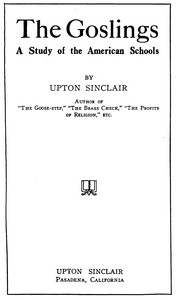
The Goslings: A Study of the American Schools by Upton Sinclair
Most of us know Upton Sinclair as the muckraker who exposed the horrors of the meatpacking industry in The Jungle. In The Goslings, he trains that same relentless focus on a different kind of system: the American public school. Published in 1924, this isn't a novel. It's a work of impassioned nonfiction, a piece of investigative journalism that digs into how schools were run, funded, and what they were truly teaching.
The Story
There's no traditional plot with characters. Instead, Sinclair presents a case. He gathers facts, testimonies, and financial records to build an argument. He shows how school boards were often controlled by local business interests. He examines textbooks that glorified capitalism and downplayed labor movements. He reveals the pitiful wages paid to teachers (mostly women), arguing this kept them dependent and unable to challenge the status quo. The 'story' is the uncovering of a system he believes is designed not to uplift, but to produce compliant 'goslings' who won't question the economic order. He contrasts this with glimpses of alternative, progressive schools, painting a picture of what education could be.
Why You Should Read It
This book is a shock to the system. Reading it, you realize how little has changed in a century. The fights over school funding, curriculum control, and teacher pay? Sinclair was there a hundred years ago. His writing is direct and charged with moral outrage, which makes it compelling even when the subject seems dense. It forces you to ask fundamental questions: Who benefits from the way we teach history? What's the real purpose of mass education? While his solutions are rooted in his socialist views, the problems he identifies transcend ideology. It makes you look at your own schooling in a completely new light.
Final Verdict
This is not a light read, but it's an important one. It's perfect for history buffs who want to go beyond dates and battles, for teachers and parents knee-deep in today's education wars, and for anyone who enjoys sharp, opinionated nonfiction that challenges comfortable assumptions. If you've ever sat in a classroom and wondered 'why are we learning it this way?' Sinclair provides a century-old, fiercely argued answer. Approach it not as absolute truth, but as a powerful provocation—one that's still remarkably relevant.
This is a copyright-free edition. Thank you for supporting open literature.
Sandra Lopez
1 year agoThis book was worth my time since the depth of research presented here is truly commendable. Exceeded all my expectations.
Richard Thompson
1 year agoEssential reading for students of this field.
Deborah Brown
5 months agoI was skeptical at first, but it provides a comprehensive overview perfect for everyone. This story will stay with me.
Donna Clark
1 year agoI didn't expect much, but it creates a vivid world that you simply do not want to leave. Truly inspiring.


Ashley Harris
10 months agoI wanted to compare this perspective with traditional views, the critical analysis of current industry standards is very timely. Well worth the time invested in reading it.