
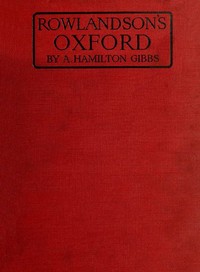
Rowlandson's Oxford by A. Hamilton Gibbs
John Rowlandson arrives in Oxford, a young American ready to soak up the history and prestige. But his academic plans are quickly sidetracked when he stumbles upon a strange architectural anomaly in his own college—a window that doesn't match old building plans, and a series of cryptic markings nearby. His curiosity leads him to a forgotten story from the 1640s, involving a Royalist scholar who supposedly hid something of great value just before Cromwell's troops stormed the city. As John starts piecing the clues together, he realizes he's not the only one interested. He meets Eleanor, a sharp local history student, but also draws the wary attention of college officials and a shadowy collector, all of whom seem to want him to stop looking.
The Story
The plot is a classic treasure hunt, but with a very Oxford twist. It's less about action and more about deduction, research, and understanding the clues left in stone and old manuscripts. John and Eleanor become a team, racing against those who want the secret to remain lost. The tension builds not from chases, but from the quiet threat of being expelled, of social ruin, and of a legacy being erased. The real question becomes: is the treasure a physical object, or is it the truth itself that's valuable? The resolution is satisfying and clever, tying the past's conflict directly to the present.
Why You Should Read It
Gibbs absolutely nails the atmosphere. You can feel the chill of the stone corridors, the weight of tradition, and the excitement of discovery. John is a great guide—his outsider perspective lets us see Oxford's wonders and its stuffiness with fresh eyes. His friendship with Eleanor feels real and grounded. What I loved most was how the book made history feel active and urgent. It argues that the past isn't just names and dates in a book; it's physical, it's hidden in our buildings, and it sometimes needs someone from the outside to see it clearly.
Final Verdict
This is a cozy, intelligent mystery for anyone who loves history, architecture, or academia. It's perfect for fans of Dorothy L. Sayers' Gaudy Night or anyone who enjoys a puzzle where the library is the most important room. You don't need to be an Oxford scholar to enjoy it—Gibbs explains everything you need to know. It's a quiet, charming book that proves you don't need villains with guns to create real stakes; sometimes, the threat to a person's future and a centuries-old truth is tension enough.
This masterpiece is free from copyright limitations. You do not need permission to reproduce this work.
Andrew Scott
2 months agoVery interesting perspective.
Linda Flores
11 months agoSolid story.
Matthew Williams
1 year agoSimply put, the flow of the text seems very fluid. I will read more from this author.
Steven Anderson
1 year agoNot bad at all.





Susan Young
2 months agoGood quality content.